
What Is a GST Invoice? A Quick Guide for Indian Businesses
If you’re a GST-registered dealer, issuing a proper GST invoice isn’t optional — it’s the law. Every time you supply taxable goods or services, you need to raise an invoice that follows GST rules.
Beyond compliance, a correct GST invoice does two important jobs for your business:
- It lets you charge tax correctly.
- It lets your customers claim input tax credit (ITC).
Getting the format right matters — for you and for the people you bill.
That’s where good GST billing software comes in. It takes the guesswork out of invoicing, applies the right fields automatically, and helps you send accurate invoices in seconds instead of hours.
Here’s everything that needs to go into a valid GST invoice.
Mandatory Fields in a GST Invoice
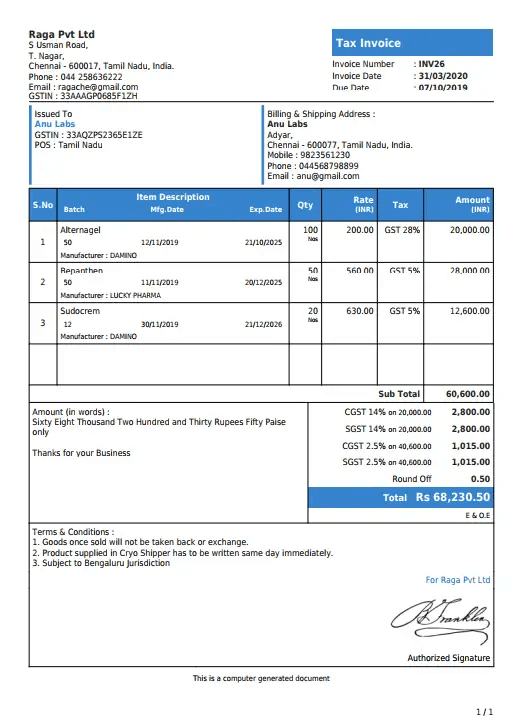
A compliant tax invoice under GST must include:
- Supplier details — name, address, and GSTIN
- Invoice number — a unique serial number tied to the financial year
- Invoice date
- Customer details
- If registered: name, address, and GSTIN
- If unregistered and invoice value exceeds ₹50,000: name, address, delivery address with state name and code
- HSN code for goods, or accounting code for services
- Not required if turnover is below ₹1.5 crore
- 2-digit HSN code if turnover is between ₹1.5 crore and ₹5 crore
- 4-digit HSN code if turnover exceeds ₹5 crore
- Description of goods or services
- Quantity and unit (for goods)
- Total value of supply, including any discount
- Tax rate applied
- Tax amount charged
- Place of supply
- Delivery address, if different from the place of supply or billing address
- Whether tax is payable on reverse charge
- Signature or digital signature of the supplier
- For exports: the endorsement “Supply Meant for Export on Payment of IGST” (or the applicable invoice type), along with the buyer’s name, address, delivery address, country, and export application details
Missing even one required field can create compliance issues — which is why automating this with the right software saves you from manual errors.
When Should You Issue a GST Invoice?
Timing matters under GST. Here’s the breakdown.
For supply of goods, the invoice must be issued:
- Before or at the time goods are removed for delivery, if the supply involves movement of goods
- At the time of delivery, if the supply doesn’t involve movement of goods
- At the time an account statement or payment is issued, for continuous supply
For supply of services, the invoice must be issued:
- Within 30 days from the date of service
- Within 45 days, if you’re a bank or financial institution
Missing these windows can lead to penalties — another reason to let software handle the timing and reminders for you.
How Many Copies of a GST Invoice Do You Need?
The number of copies depends on whether you’re supplying goods or services.
| Supply of Goods | Supply of Services |
|---|---|
| Original — for the recipient | Original — for the recipient |
| Duplicate — for the transporter (not required if you have an Invoice Reference Number from the GST portal) | Duplicate — for the supplier |
| Triplicate — retained by the supplier | — |
What Is a Bill of Supply?
A Bill of Supply looks similar to a GST invoice, but with one key difference: it doesn’t show any tax amount.
You’ll need to issue a Bill of Supply when:
- You’re supplying exempted goods or services
- You’ve opted into the Composition Scheme
Stop Worrying About GST Compliance — Let Your Software Handle It
Manually tracking invoice formats, HSN codes, and issue deadlines takes time you could be spending on your business.
Output Books’ GST billing software generates fully compliant invoices automatically — right fields, right format, every time.
- ✅ Auto-filled GST invoices in seconds
- ✅ Built-in HSN/SAC code handling based on your turnover
- ✅ Never miss an invoicing deadline
- ✅ Easy Bill of Supply generation for exempted sales
Ready to simplify your GST billing?
👉 Try Output Books free today and see how effortless GST invoicing can be.